Travel Agency Sitev0.1.1
Use this Skill to build a product website.
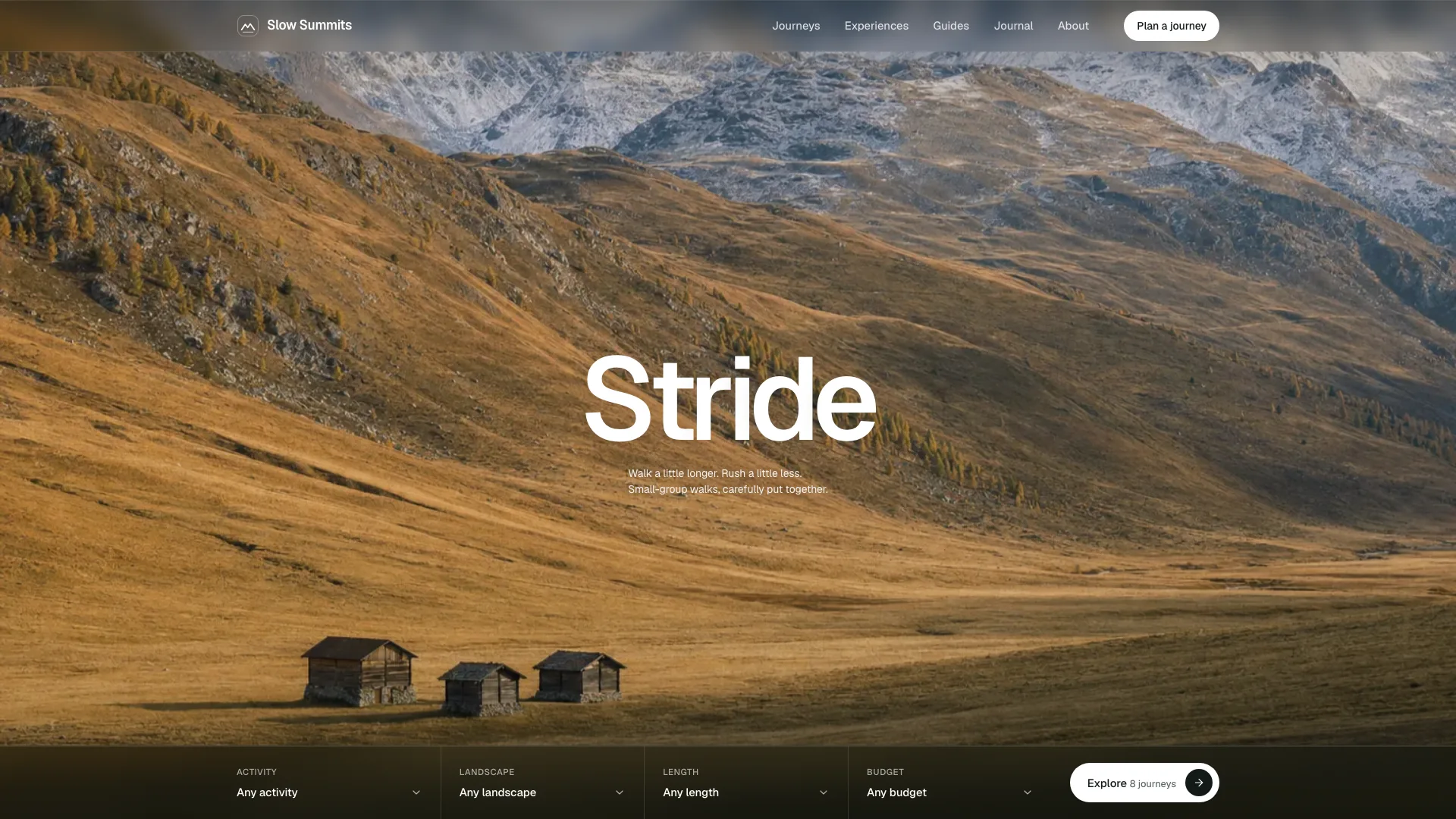
A travel website skill for Fable 5 and small walking or tour companies: 30 routes in one file, a mountain hero with one huge word and glass search, filtered journeys, booking and a quiz.
Picked most often by
Updated Oct 31, 2026
Preview gallery


Similar Skills
View all
What you get
- A single offline HTML file of 30 linked routes that reads fine with JavaScript off
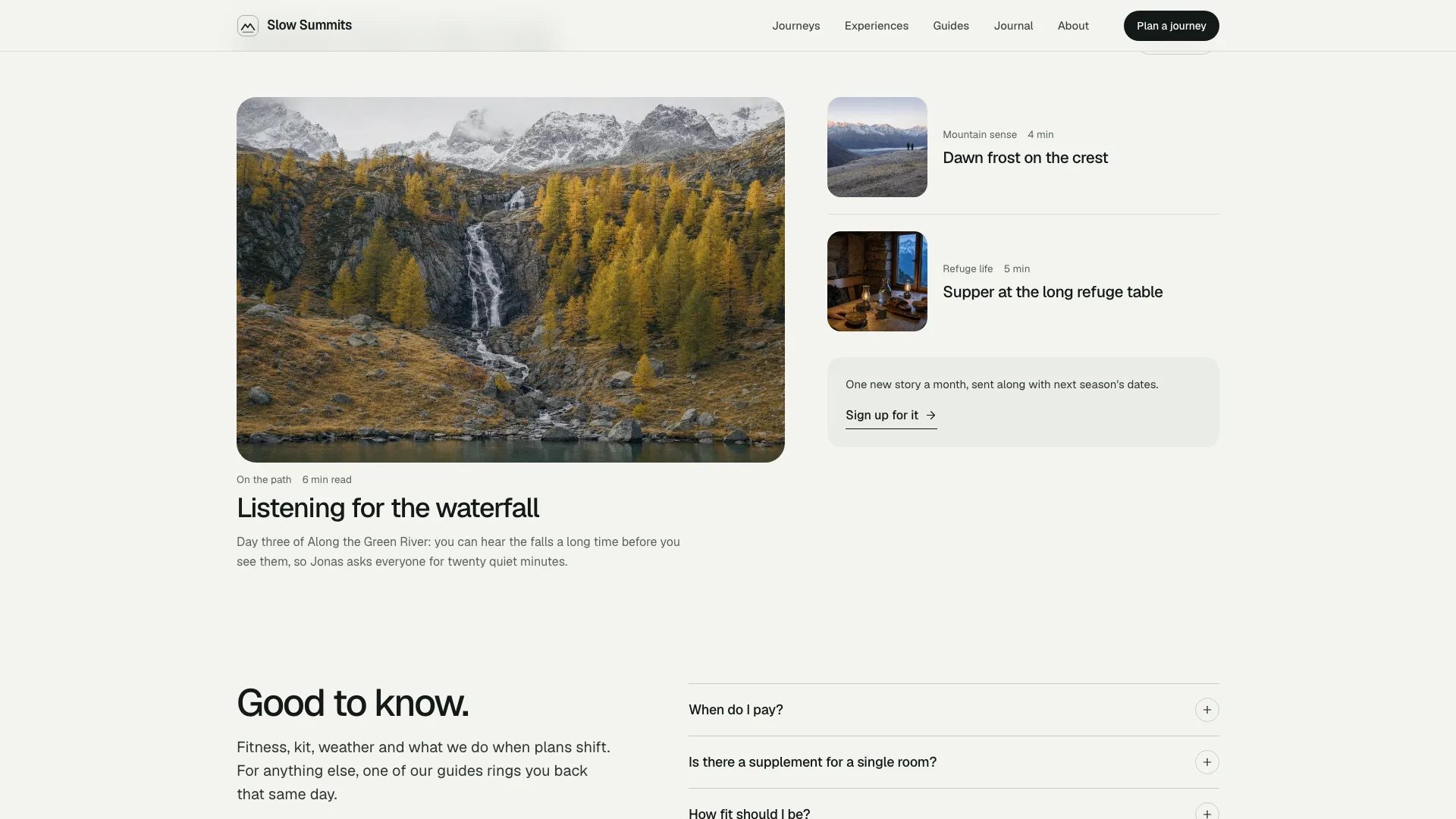
- Home: a mountain-photo hero whose glass search bar shows live counts, then a stepped collage, a journeys rail, seasonal departures, a principles bento, the guides band, postcards, journal and questions
- A journeys page with activity chips, filters for scenery, length and budget, sorting, search, a reset and an empty state
- One page per journey: photo, key facts, highlights, an elevation profile, the itinerary day by day, inclusions, a strip of months, the guide's card and a booking panel that keeps a running total and deposit
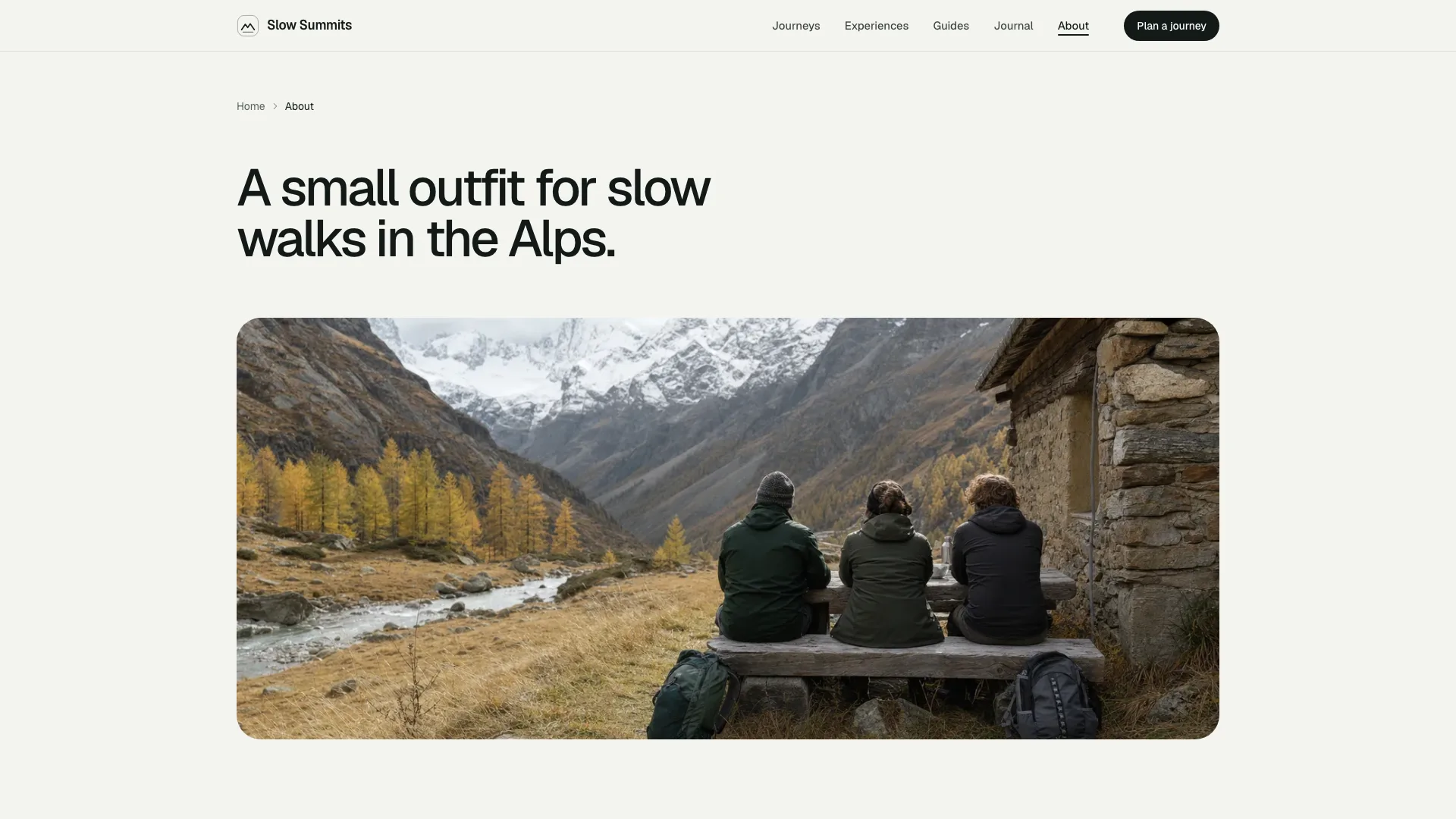
- Ways to travel compared in a table, with a page for each; retreats; guides with individual profiles; a journal of full stories
- A booking request that picks up the chosen journey and departure, plus contact, newsletter, searchable questions, a three-question quiz and a designed 404
- Open-source fonts and icons embedded, with TravelAgency structured data
Good fit
- Walking and trekking companies running small groups
- Tour operators with a few signature trips
- Lodges, huts and destination teams selling itineraries
Not for
- Taking real bookings or payment: the request form is only a demo
- Big catalogs with hundreds of departures
- Availability synced in real time
About this Skill
Small walking companies sell trips people dream about for months, so this Skill leads with the landscape. Your Fable 5 agent takes the operator's real journeys, dates, guides and prices and returns one offline HTML file. The first screen is a full mountain photograph with one large white word on it and a dark glass search bar along the bottom, where four filters count matching trips as you choose. Below comes a stepped photo collage, a rail of journeys, departures grouped by season, the company's principles in a bento, a band introducing the guides, postcards from guests, the journal and frequent questions. On the journeys page travelers filter by activity, scenery, length and budget, then sort or search. Each journey's page draws an elevation profile from its itinerary, opens day by day in an accordion and says what the price includes; its booking panel adds up guests, single rooms and the deposit, then hands the selection to the booking request. Pages for retreats, ways to travel, guides and stories, plus a three-question quiz, contact and newsletter sign-up, round it out. The page says plainly that nothing is sent or charged.
How it works
- Collect the operator's journeys and itineraries, dates and prices, guides and office details
- Fill in site.json from the example brief, omitting what is unknown
- Shoot, generate or import the photos the image plan lists: the hero, one for each journey, portraits of the guides and editorial scenes
- Build, and read the full list of problems the script finds in the brief
- Validate that it is one file with one h1 per page, resolving links, labeled controls and photos
- Try search, filters, the booking panel and request, contact and the quiz at 390, 768, 1024 and 1440 px
- Deliver the file plus a list of facts the operator still needs to confirm
Checked before delivery
- validate.mjs passes: single file, one h1 per page, every link resolves, labelled controls, structured data
- Every price, date, place, altitude, guide fact and policy matches the brief; no invented qualifications, awards or safety claims
- Hero search, filters, rail, season and guide tabs, booking panel, booking form, contact, FAQ search and the quiz work at widths of 390, 768, 1024 and 1440 px
What you need before you start
- You bring
- Brand name, office address, hours, phone and email · Journeys with real regions, days, levels, prices, single supplements, months, itineraries (distance, climb, altitudes, beds), inclusions and travel notes · Ways to travel, guides with portraits, bases, years and qualifications, departures with places left · Stories, guest postcards, FAQs, partner houses for extra nights, the founding story, timeline and a price breakdown
- Dependencies
- Node.js 20 or later · No installs, API keys or network access
- Outside costs
- None
- Last tested
- v0.1.1 — Claude Code / Codex / Cursor
User reviews
Loading reviews…
FAQ
Can travelers actually book and pay?
No. The form is checked, a request summary with a reference appears, and the page says plainly that no place was held and nothing charged. A live site needs a booking system.
How is the elevation profile drawn?
From the operator's brief, where each day gives its distance, climb and altitudes. The build never invents routes, grades or qualifications.
Who provides the photographs?
The operator, where possible. Otherwise each slot has its own prompt in the image plan, written to one art direction.
Could a lodge or tourist board use it?
Yes. For a lodge the sections become rooms and packages; for a tourist board, places and routes. The Skill says which to rename and which to keep.